

Have you ever met someone who wasn’t necessarily the most book-smart person in the room, but they just… got people? They could walk into any social situation and navigate it with ease, making friends, influencing decisions, and leaving a great impression.
This person isn’t a magician; they’re just armed with a powerful, often overlooked, skill: social intelligence. In a world obsessed with IQ scores and academic achievements, we often forget that the ability to connect with others is a superpower in its own right.
So, what is this elusive skill, and how can you cultivate it to become more influential in your own life?
Decoding Social Intelligence: What Does It Actually Mean?
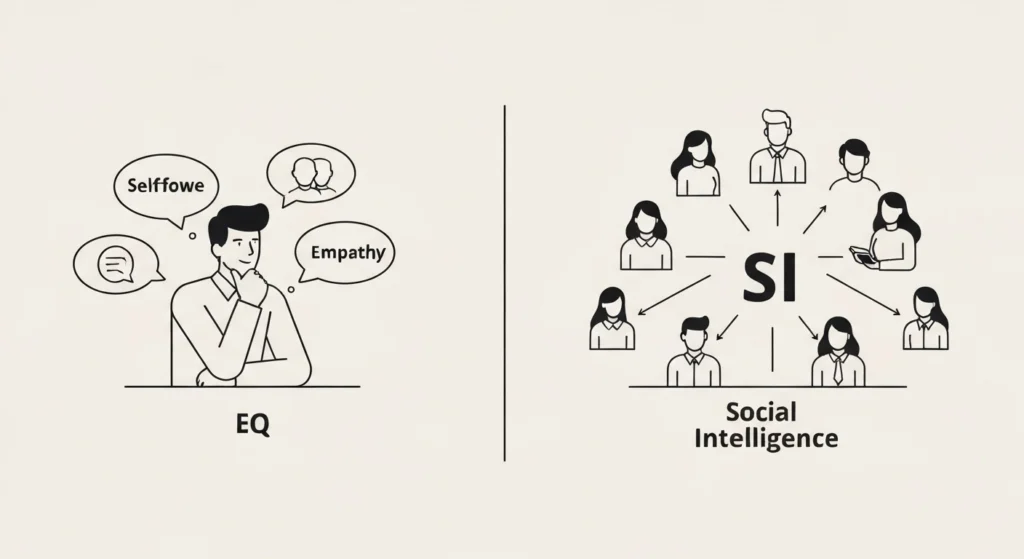
Let’s break it down. At its core, social intelligence (SI) is your ability to understand your own and others’ emotions and behaviors and use that understanding to navigate social situations successfully.
Think of it as your internal “social GPS.” While your IQ helps you solve a complex math problem, your SI helps you navigate a complex team meeting, a first date, or a difficult conversation with a friend.
It’s easy to confuse social intelligence with emotional intelligence (EQ), but there’s a key difference. Emotional intelligence is about recognizing and managing your own emotions and understanding the emotions of others.
Social intelligence is the application of that emotional data in real-time social interactions. You can have high EQ and understand someone is upset, but SI is what gives you the wisdom to know what to say (or what not to say) in that moment. It’s the difference between knowing the weather forecast and knowing how to dress for the day.
The Core Components of a High Social IQ
Psychologist Karl Albrecht developed a fantastic acronym, S.P.A.C.E., to break down the key pillars of social intelligence. Mastering these five areas is your roadmap to a higher social IQ.
- Situational Awareness (S): This is your ability to read the room. It’s about being a social detective, picking up on the unspoken cues—the subtle shifts in body language, the tone of voice, and the overall energy of a space. Someone with high situational awareness notices when a topic is making someone uncomfortable or when the group’s mood is shifting, and they adjust their behavior accordingly.
- Presence (P): How do you show up? Your presence is the collection of signals you send out through your posture, your eye contact, and your overall demeanor. It’s the vibe you give off. A strong, confident presence doesn’t mean being the loudest person in the room; it means being comfortable in your own skin, which in turn makes others feel comfortable around you.
- Authenticity (A): In a world full of filters and facades, people crave genuine connection. Authenticity is about being real. It’s when your words and actions align with your true self. This doesn’t mean oversharing or having no filter; it means being honest and transparent in a way that builds trust. People are naturally drawn to those they perceive as genuine.
- Clarity (C): Can you get your point across effectively? Clarity is the ability to express your thoughts, ideas, and feelings clearly and persuasively. It’s about choosing the right words, using effective language, and ensuring your message is understood exactly as you intended. This is crucial for everything from asking for a raise to explaining your feelings to a partner.
- Empathy (E): This is perhaps the most critical component. Empathy is the ability to step into someone else’s shoes and truly understand their perspective and feelings. It’s different from sympathy, which is feeling for someone. Empathy is feeling with someone. It’s the glue that holds all social connections together, allowing you to build rapport and deep, meaningful relationships.
Why Bother? The Real-World Benefits of Being Socially Intelligent
Developing your social intelligence isn’t just a “nice-to-have” skill for charming people at parties. It has profound, tangible benefits that can transform your personal and professional life.
For starters, your career will thank you. Socially intelligent individuals make better leaders, more effective team players, and more skilled negotiators. They can inspire and motivate others, resolve conflicts gracefully, and build powerful professional networks that open doors to new opportunities. Check also top management skills for career success to see how SI connects with leadership.
Your relationships will deepen. By understanding people better and communicating more effectively, you’ll build stronger, more resilient bonds with friends, family, and romantic partners. You’ll navigate disagreements with less friction and foster a greater sense of connection and intimacy.
Ultimately, social intelligence helps you become a more influential and persuasive person, not through manipulation, but through genuine understanding and connection. (Related: relationship building secrets)
Your Action Plan: 5 Practical Steps to Boost Your Social Intelligence

The best news? Social intelligence isn’t a fixed trait you’re born with. It’s a muscle you can train. Here are five simple exercises to get you started:
- Become a Master Observer: The next time you’re in a coffee shop or a public space, put your phone away and just watch. Pay attention to how people interact. Notice their body language, their facial expressions, and their tone. Try to guess the context of their conversations. This practice sharpens your situational awareness.
- Practice Active Listening: Most of us listen with the intent to reply, not to understand. Try this: In your next conversation, make it your goal to simply understand the other person’s point of view. Paraphrase what they said back to them (“So, what I’m hearing is…”) to ensure you’ve got it right. You’ll be amazed at how this simple shift deepens conversations. (See also developing communication skills).
- Expand Your Empathy Muscle: Make a conscious effort to see situations from other people’s perspectives, especially when you disagree with them. Ask yourself, “What might they be feeling or experiencing that is leading them to this conclusion?” Reading fiction is another great way to live vicariously through different characters and expand your empathetic range. Related read: developing emotional intelligence.
- Pay Attention to Your Presence: How do you enter a room? Do you slouch and avoid eye contact, or do you stand tall and offer a warm smile? Small adjustments to your posture and body language can significantly change how others perceive you and, more importantly, how you feel about yourself.
- Seek Gentle Feedback: Ask a trusted friend, colleague, or mentor for some honest feedback. You could ask something like, “Is there anything about my communication style that is sometimes unclear?” or “How do I come across in team meetings?” Be open to their observations—it’s invaluable data for your growth.
Your Journey to Becoming More Influential Starts Now
In the end, social intelligence is the art and science of human connection. It’s not about being an extrovert or the life of the party; it’s about being aware, present, and empathetic in your interactions. Unlike your IQ, which remains relatively stable throughout your life, your social intelligence is something you can actively develop and improve every single day.
By focusing on these skills, you’re not just learning to navigate social situations—you’re learning how to build stronger relationships, advance your career, and become a more effective and influential person.
Your journey starts with a single step, a single conversation. Are you ready to take it?