
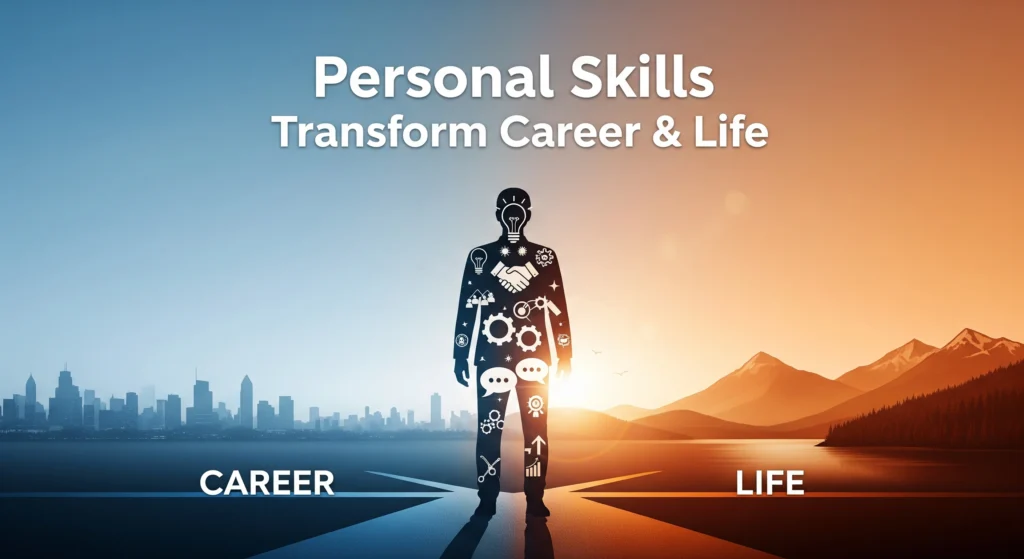
Let’s be real. We spend years learning technical skills—how to code, how to use specific software, how to analyze a balance sheet. These “hard skills” are essential, and they absolutely get you in the door. But here’s the secret: they aren’t what make you successful. They aren’t what get you promoted, what build a lasting career, or what lead to a fulfilling life.
Think of your hard skills as a high-performance engine. It’s powerful, sure. But without a steering wheel, brakes, and a skilled driver, that engine is useless. It’ll just crash. Your personal skills—those often-dismissed “soft skills”—are the steering wheel. They are the true power skills that let you navigate challenges, build relationships, and actually use your technical expertise to its fullest potential.
Ready to see what they are?
Category 1: Mastering How You Connect with Others
This first group is all about how you interact with the world and the people in it. You can be a genius, but if you can’t connect, you’re working in a vacuum.
1. Active Listening
I’m not talking about just waiting for your turn to talk. I mean really listening. It’s about hearing what’s said, what’s not said, and understanding the emotion behind the words. In your career, this means you’ll understand what your boss actually wants or what a client’s real pain point is. In your life, it means your friends and family feel genuinely seen and heard.
2. Emotional Intelligence (EQ)
This is the big one. Emotional Intelligence is the ability to understand and manage your own emotions, and just as importantly, to recognize and influence the emotions of others. It’s the skill that stops you from sending an angry email (self-management) and helps you rally a demotivated team (social awareness). High EQ is the single biggest differentiator between an average performer and a superstar leader.
3. Clear Communication (and Public Speaking)
If you have the best idea in the world but can’t explain it clearly, does it even exist? Clear communication isn’t about using big words; it’s about being understood. It’s writing a simple email, giving clear instructions, and yes, the big one: public speaking. Even if you just present to a team of three, the ability to articulate your thoughts confidently is a game-changer.
4. Empathy
Empathy is EQ’s close cousin. It’s the ability to genuinely understand and share the feelings of another person. In your career, it helps you build amazing customer relationships and be a manager people want to work for. In your personal life, it’s the glue for every single strong relationship you have. It’s the ability to say, “I see where you’re coming from.”
5. Networking (The Right Way)
Forget the cringey image of handing out business cards at a stuffy event. Real networking is just building genuine relationships. It’s about being curious, adding value to others, and playing the long game. Your network is your safety net and your launchpad. It finds you new jobs, new clients, and new friends.
Category 2: Mastering How You Manage Yourself
This group of skills is internal. It’s about how you handle the pressure, chaos, and responsibility of your own life.
6. Adaptability & Flexibility
The world is not going to slow down for you. New technology, new company strategies, new bosses, or even a global pandemic—change is the only constant. Are you the rigid oak that snaps in the wind, or the flexible reed that bends and survives? Adaptability is the key to resilience and long-term relevance in any field.
7. Time Management & Prioritization
We all have the same 24 hours. The difference between “always busy” and “highly productive” is prioritization. This skill isn’t really about managing time; it’s about managing yourself. It’s knowing the difference between what is urgent and what is important. It’s the skill that gives you back your weekends.
8. Resilience & Grit
You are going to fail. You’ll get rejected. A project will bomb. You’ll face setbacks. Resilience is not about avoiding these hits; it’s about how quickly you get back up. Grit is the passion and perseverance to stick with long-term goals. This combination is what carries you through the tough times—in work and in life.
9. Self-Awareness
Do you truly know your strengths, weaknesses, triggers, and biases? Self-awareness is the foundation of all personal growth. It’s the internal compass that lets you say, “I’m not good at this, so I’ll ask for help,” or “I’m getting frustrated, I need to take a break.” Without this map, you’re just walking in circles.
10. Proactivity (Taking Initiative)
This is the difference between a passive employee and a future leader. Proactive people don’t wait to be told what to do. They see a problem and fix it. They ask “what if?” and “how can we make this better?” In your life, this means solving problems before they become full-blown crises.
Category 3: Mastering How You Think and Act
These skills are about your cognitive and practical approach to challenges. How do you think, and what do you do with that thought?
11. Critical Thinking & Problem-Solving
In a world overflowing with information, misinformation, and noise, this is your filter. Critical thinking is the ability to analyze information objectively and make a reasoned judgment. It’s the skill that helps you see the root of a problem, not just its symptoms. This is invaluable everywhere, from debugging code to figuring out a family budget.
12. Creativity
Creativity isn’t just for artists and musicians. It’s about connecting the dots in new ways. It’s finding a new solution to an old, nagging problem. It’s the marketing manager who tries a new campaign, the engineer who optimizes a process, or the parent who invents a new way to get their kids to eat vegetables. Creativity is simply applied imagination.
13. Financial Literacy
This skill will change your life. Period. You don’t need to be a Wall Street trader, but you must understand budgeting, the danger of high-interest debt, and the power of compound interest. This skill reduces your stress, gives you freedom, and allows you to build a secure future. Your career can’t thrive if your personal life is a financial mess.
14. Negotiation
Guess what? You negotiate every single day. From your salary and your rent to where you’re going for dinner with friends. Good negotiation isn’t about “winning” or being a bully. It’s the art of communicating to find a mutually beneficial solution. This skill alone can save you (and earn you) tens of thousands of dollars over your lifetime.
15. Learning to Learn (Lifelong Learning)
This is the master skill that fuels all the others. Your technical skills will become outdated. The software you master today will be obsolete in five years. Your ability to learn new things quickly, efficiently, and continuously is your ultimate career insurance. It’s a mindset of curiosity that keeps you engaged and relevant for life.
Your Transformation Starts With a Single Step
Looking at this list of 15 skills, it’s easy to feel overwhelmed. Don’t be. Nobody is born a master of all these things. Every single one is a skill, which means it can be built. They are muscles that get stronger with practice.
The transformation in your career and life doesn’t happen by trying to fix all 15 at once. It starts by picking one. Just one. Choose the one that resonates most with you, or the one you know is your biggest weakness, and start working on it today. Your future self will thank you.