Let’s be honest for a second. The old idea of a “career ladder” is dead. You know, the one where you join a company right out of school, keep your head down for 40 years, and slowly climb one predictable rung at a time? That was your grandfather’s career. Today, we’re all navigating what I like to call the “career jungle gym.” We swing sideways to a new industry, we climb down to a different role to move up faster, and sometimes we just hang out on one bar for a while to catch our breath.
In this new, dynamic, and sometimes chaotic world of work, what’s the one thing that helps you move with confidence? It’s not your job title. It’s not the fancy logo on your business card. It’s your skills. Your skills are your new currency. They are the portable, valuable assets you carry with you wherever you go, from job to job, from industry to industry. They are what make you valuable, adaptable, and, ultimately, successful.
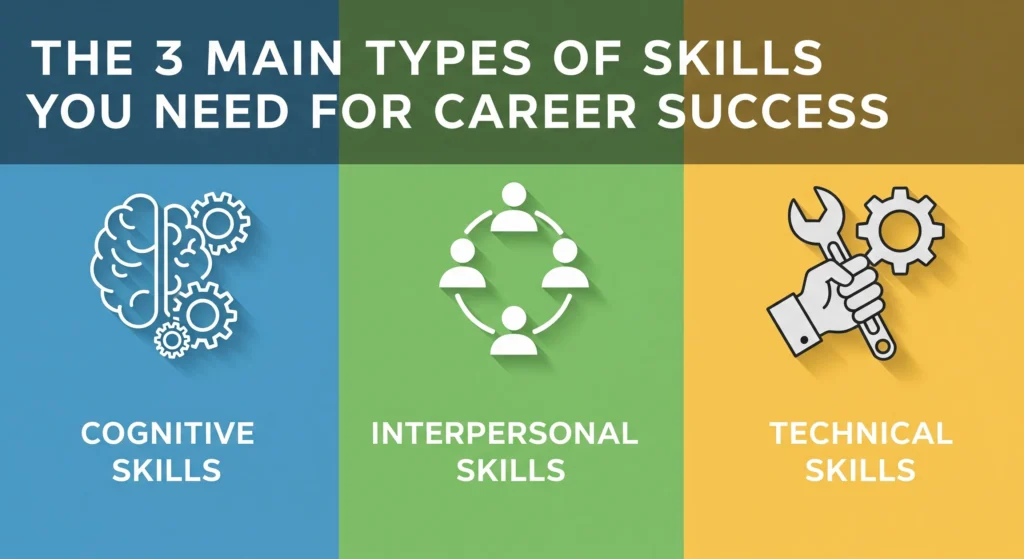
But here’s the catch that most people miss: not all skills are created equal. We tend to talk about “skills” like it’s just one big, messy bucket. It’s not. If you really want to build a successful, future-proof career, you need to understand the “Trifecta of Talent.” You need to master the three main types of skills. So, what are they, and how can you start building them right now? Let’s dive in.
Pillar 1: Hard Skills (The “What”) – Your Technical Toolkit
What Exactly Are Hard Skills?
First up, we have the most obvious category: Hard Skills. These are the technical, teachable, and tangible abilities you need to perform a specific job. They are the skills you can list on a resume that make a hiring manager nod and say, “Okay, this person is qualified.” Think of it this way: if your career was a car, your hard skills would be the engine. They provide the raw power to get the job done.
These skills are “hard” because they are concrete and measurable. You can prove you have them. You either know how to code in Python, or you don’t. You’re either fluent in German, or you’re not. You can either design a logo in Adobe Illustrator, perform heart surgery, or balance a financial spreadsheet. There’s very little gray area. These are the skills you learn in school, through online courses, or from certification programs.
Why Hard Skills Are Your Non-Negotiable Foundation
In a world that’s (rightfully) obsessed with soft skills, it’s easy to forget that hard skills are still the price of admission. They are your non-negotiable foundation. You can be the best communicator in the world, but you can’t get a job as a data scientist if you don’t know SQL or R. You can’t get a job as a graphic designer if you don’t know how to use the design software.
Hard skills are what get your resume past the automated filters and onto a human’s desk. They are the foundation of your competence. They build your credibility and give you the confidence to actually do the work. When you have a strong set of hard skills, you’re not just guessing; you know what you’re doing. That confidence is the starting line for any successful career.
How to Identify the Right Hard Skills for Your Field
So, which hard skills do you need? It’s easy to get overwhelmed. The best place to start is by playing detective. Go to LinkedIn or any major job board and search for the job titles you want to have in the next five years. Read through 10 or 20 of those job descriptions. What tools, software, and methodologies keep popping up? Is it “Salesforce”? “Tableau”? “Agile methodology”? That’s your shopping list.
But don’t just blindly chase the “hot” skill of the month. A few years ago, everyone was screaming “Big Data.” Now, it’s “AI prompt engineering.” While it’s critical to watch industry trends, you have to align them with your actual interests. You will never, ever get truly great at a hard skill you hate. If you’re a creative person, maybe data analysis isn’t your path, but mastering the latest 3D modeling software is.
The Best Ways to Develop and Prove Your Hard Skills
Okay, so you’ve identified a skill gap. How do you fill it? Formal education is the classic path. A university degree or a college diploma is still a fantastic way to build a deep, foundational knowledge base. But let’s be realistic: not everyone has the time or money for a four-year degree just to learn a new skill. This is where the internet becomes your greatest ally.
Online courses from platforms like Coursera, Udemy, edX, and LinkedIn Learning are absolute gold. You can learn from top-tier university professors and industry experts at your own pace, often for a fraction of the cost. Beyond courses, look for certifications. A formal certification (like a Project Management Professional (PMP), an AWS Cloud Practitioner, or a Google Analytics certification) is a stamp of approval. It tells employers, “I didn’t just watch the videos; I passed the test.”
But here’s the most important part: you have to prove it. A certificate is nice. A portfolio is powerful. If you’re a writer, have a blog. If you’re a coder, have a GitHub repository with your projects. If you’re a designer, have a Behance or Dribbble profile. Show, don’t just tell. Build something. Create a project from scratch. That hands-on experience is worth more than any line item on a resume.
Pillar 2: Soft Skills (The “How”) – Your Human Superpower
What Are Soft Skills, Really? (And Why They’re So “Hard” to Master)
If hard skills are the engine of your car, Soft Skills are the driver. You can have a 1,000-horsepower engine, but if the driver can’t steer, communicate with other drivers, or handle the pressure of traffic, that car is going straight into a wall. Soft skills are your interpersonal, behavioral, and character traits. They’re all about how you work with people and how you approach your work.
We call them “soft,” but honestly, they’re the hardest skills to develop. It’s relatively easy to learn a new piece of software. It’s incredibly difficult to unlearn a bad communication habit or teach yourself to be more patient and empathetic. These are the human-centric skills: how you listen, how you build relationships, how you solve problems, and how you manage your own emotions.
The “Big 5” Soft Skills Employers Are Desperate For
You can find lists of 50+ soft skills online, but let’s cut through the noise. When you boil it all down, there are five core skills that employers are desperately looking for. If you can master these, you will be invaluable.
1. Communication (The Undisputed Champion)
This is it. The big one. Communication is the root of all success and all failure in the workplace. But it’s so much more than just being able to talk clearly. It’s about writing an email that doesn’t get misunderstood. It’s about presenting a complex idea to a client in simple, confident terms. It’s about knowing when to use Slack, when to send an email, and when to just pick up the phone.
The most overlooked part of communication? Listening. We’re all so busy thinking about what we’re going to say next that we fail to actually hear what the other person is saying. Active listening isn’t just waiting for your turn to talk. It’s about hearing what’s not being said. It’s understanding the intent and emotion behind the words. In a world of remote work, your ability to communicate with clarity and empathy is your single greatest asset.
2. Collaboration and Teamwork
The “lone genius” trope you see in movies is a myth. Almost nothing great is built by one person. Your ability to play well with others is non-negotiable. This means knowing when to lead and when to follow. It means being able to disagree with a colleague productively and respectfully, without making it personal. It’s about building on someone else’s idea instead of just shutting it down.
Collaboration is about finding the shared goal. It’s about subverting your own ego for the good of the project. Can you navigate different personalities? Can you motivate a teammate who’s having a bad week? Can you build consensus in a meeting that’s going nowhere? If you can, you’re what’s known as a “force multiplier”—someone who makes the entire team better just by being on it.
3. Problem-Solving and Critical Thinking
Here’s a secret your boss wishes you knew: they don’t want you to just do tasks. They want you to solve problems. Anyone can follow a to-do list. But what happens when the list doesn’t work? What happens when the client is angry, the code is broken, or the data doesn’t make sense? Do you freeze and wait for instructions?
This is where critical thinking comes in. It’s the ability to analyze a situation, identify the root cause of the problem (not just the symptom), and evaluate potential solutions. A problem-solver is the person who says, “This is broken. I’ve looked into it, and I think it’s because of X. I have two ideas for how we can fix it. Do you have a preference?” That person is gold.
4. Adaptability and Resilience
Remember that career jungle gym? Well, it’s constantly changing. A new boss, a new software system, a new company strategy, a global pandemic… something is always shifting under your feet. Adaptability is your ability to pivot without panicking. It’s about letting go of “the way we’ve always done it” and embracing a new challenge. It’s seeing change as an opportunity, not just a threat.
Hand-in-hand with adaptability is resilience. You will fail. It’s guaranteed. A project you lead will bomb. You’ll get feedback that stings. You’ll get passed over for a promotion you deserved. Resilience is your bounce-back. It’s not about if you get knocked down; it’s about how fast you get back up, what you learned from the fall, and how you apply that lesson moving forward.
5. Emotional Intelligence (EQ)
This one might be the most powerful of all. Emotional Intelligence (EQ) is the secret sauce. It’s made of two main parts: self-awareness and empathy. Self-awareness is knowing your own triggers. It’s recognizing when you’re feeling defensive, stressed, or angry, and choosing not to let that feeling drive your actions. It’s the pause between the stimulus and your response.
The other half, empathy, is the ability to see the world from someone else’s perspective, even if you don’t agree with them. It’s understanding why your coworker is so frustrated about the deadline. High EQ allows you to build trust, manage conflict, and create real, strong professional relationships. You can be the most brilliant person in the room, but if you have low EQ, nobody will want to be in that room with you.
Why Soft Skills Are Your Greatest Career Accelerator
Here’s the career formula you need to remember: Hard skills open the door. Soft skills get you promoted. Your technical skills might get you the entry-level job, but your communication, teamwork, and problem-solving skills are what get you the next job, the raise, or the leadership position. Managers don’t promote the “brilliant jerk.” They promote the effective collaborator who makes everyone around them better.
Plus, let’s talk about the elephant in the room: AI. Artificial intelligence is getting better and better at hard skills. It can write code, analyze data, and even design logos. But what can’t it do? It can’t show empathy to an upset client. It can’t mentor a junior employee. It can’t navigate the complex human politics of a team meeting. Your soft skills are your human differentiator.
How to Actively Develop Your Soft Skills (Starting Today)
So how do you get better at these “human” skills? It’s not like taking a coding class. The number one way is to ask for feedback. Go to your boss, a trusted colleague, or a mentor and ask this specific question: “What’s one thing I could do to be a better communicator/collaborator?” Then—and this is the hard part—shut up and listen. Don’t get defensive. Don’t make excuses. Just say, “Thank you, I’m going to work on that.”
Practice active listening in your next conversation. Join a group like Toastmasters to work on your public speaking. Volunteer to lead a low-stakes project to build your leadership skills. Read books on psychology and human behavior. Developing soft skills is a lifelong process of self-reflection and practice. It’s a marathon, not a sprint, but every step counts.
Pillar 3: Transferable Skills (The “Bridge”) – Your Career GPS
The “Secret Weapon”: What Are Transferable Skills?
Okay, we’ve got the engine (Hard Skills) and the driver (Soft Skills). What’s left? Transferable Skills. These are your “all-terrain tires.” These are the skills that allow you to take your car off the neatly paved road of one industry and drive it through the mud, forest, and mountains of a completely different one.
Transferable skills are abilities you’ve learned in one context (a job, a hobby, school, or even parenting) that are valuable and can be applied in a completely new context. They are your “secret weapon” for making a career change, getting a promotion, or just proving your value when you don’t have 10 years of “direct experience.” They are the bridge that connects your past to your future.
How Transferable Skills Differ from Hard and Soft Skills
This is where it gets a little fuzzy, so stay with me. Many (in fact, most) soft skills are also transferable skills. Communication, for example, is valuable whether you’re a nurse, a lawyer, or a software engineer. But hard skills can be transferable, too! The difference is all about context and application.
A “hard skill” like “Data Analysis” might seem specific to a data scientist role. But it becomes transferable the moment you apply it to a marketing manager role (analyzing campaign results), a human resources role (analyzing employee retention trends), or a logistics role (analyzing supply chain efficiency). It’s the same core skill, just applied in a new field.
Key Examples of Powerful Transferable Skills You Already Have
You have more of these skills than you think. You just haven’t learned how to label them yet.
Project Management
Have you ever planned a large family vacation? A friend’s wedding? A complex school project? A charity fundraiser? Then you have project management skills. You had to manage a budget, a timeline, and a group of stakeholders (your crazy cousins included). You can apply that exact skill to launching a new product, organizing a company event, or rolling out a new software system.
Leadership
You don’t need a “manager” title to have leadership skills. Were you the captain of a sports team? Did you organize a study group in college? Do you find yourself being the one to mentor new hires, even if it’s not in your job description? That’s leadership. It’s the ability to motivate, guide, and take responsibility for a group’s outcome.
Research & Analysis
This is a big one. Did you write a 20-page research paper in college? To do that, you had to find massive amounts of information, figure out what was credible, synthesize it all, analyze it for patterns, and present a coherent argument. That exact skill is what companies pay “market researchers,” “business analysts,” and “strategists” a lot of money to do.
Sales & Negotiation
Think you’re not in sales? I hate to break it to you, but everyone is in sales. Did you ever convince your group of friends to see the movie you wanted to see? Did you successfully negotiate a higher salary or a more flexible work schedule? That’s sales and negotiation. It’s the art of understanding another person’s needs and showing them how your idea or solution meets those needs.
How to “Re-Brand” Your Skills for a Career Change
This is the most critical part. You can’t just have transferable skills; you have to sell them. You have to re-brand them for the job you want. If you’re a bartender trying to get your first corporate job, your resume shouldn’t say “Made drinks.” It should say “Managed customer relationships in a high-pressure environment,” “Operated complex point-of-sale systems,” and “Maintained inventory and cash control.” See the difference?
Use the STAR method in your cover letter and interviews. Situation: (What was the context?) Task: (What needed to be done?) Action: (What did you do?) Result: (What was the positive outcome?) Don’t just say you have “leadership skills.” Prove it with a story. That’s how you make your skills transferable.
Bringing It All Together: The Skill Synergy
Here’s the real secret. You can’t just be a “hard skills person” or a “soft skills person.” The magic, the real career success, happens in the synergy between all three. The most successful people are what we call “T-shaped professionals.” They have deep expertise in one area (the vertical bar of the “T” – their Hard Skills).
But they also have a broad set of skills that lets them collaborate across disciplines (the horizontal bar of the “T” – their Soft and Transferable Skills). Think about it. The brilliant coder who can’t explain their work to the marketing team is a liability. The amazing marketer who doesn’t understand the technical limitations of the product is ineffective. The organized project manager who has no empathy for their team will burn everyone out.
You need all three. Your hard skills give you a foundation of what you can do. Your soft skills let you how you do it with others. And your transferable skills give you the bridge to do it anywhere. The glue that holds it all together? A genuine curiosity and a commitment to lifelong learning.
Conclusion: Stop Collecting Skills, Start Integrating Them
So, there you have it. The three main types of skills you need for career success: Hard skills (the ‘what’), Soft skills (the ‘how’), and Transferable skills (the ‘bridge’). It’s the trifecta that makes you resilient, valuable, and ready for whatever the career jungle gym throws at you next.
Your career isn’t going to be built on what skills you have in a static list. It’s going to be built on how you dynamically weave them together to solve real problems for real people. So, my question to you is this: What’s the one skill—hard, soft, or transferable—that you’re going to start actively honing this week?