
Ever feel like you’re spinning your wheels? You set big, juicy goals. New Year’s resolutions. That “big project” you’re finally going to launch. But fast forward a few weeks, and you’re back to square one, lost in a sea of procrastination, scattered focus, and Netflix binges. What gives?
Is it a lack of talent? No. A lack of desire? Probably not.
It’s almost always a lack of self-management. This is the secret ingredient. It’s the unsexy, behind-the-scenes collection of skills that separates the “dreamers” from the “doers.” It’s the engine that actually gets the car to its destination.
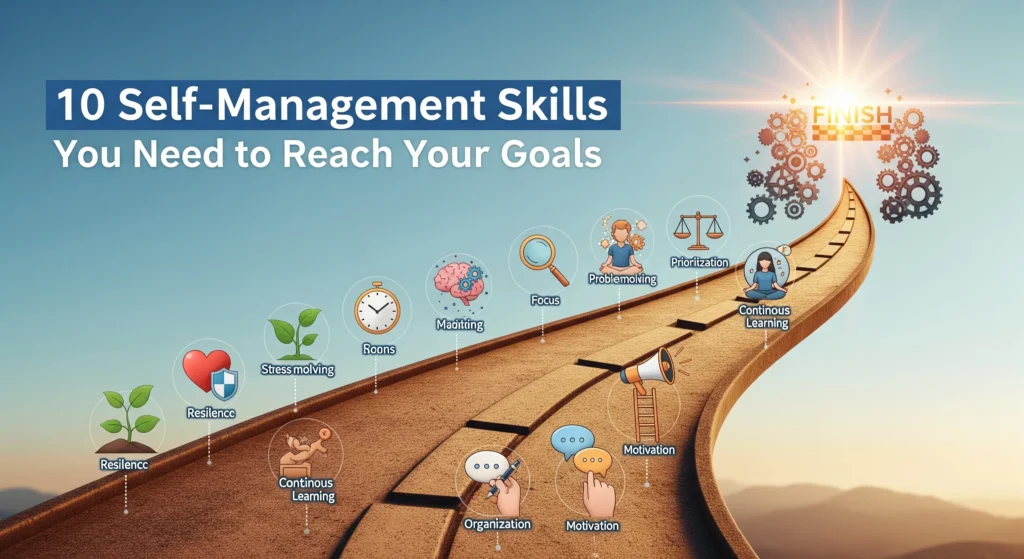
If you’re ready to stop just setting goals and start achieving them, you’re in the right place. We’re going to break down the 10 essential self-management skills that will change the game for you.
What Are Self-Management Skills, Anyway? (And Why Should You Care?)
Think of yourself as a company: “You, Inc.”
You are the CEO, the intern, the marketing department, and the janitor. Self-management skills are your complete executive toolkit. They are the practical, learnable abilities that allow you to manage your own thoughts, feelings, and actions to get the results you want.
It’s the bridge between “I want to do this” and “I did this.”
Without these skills, you’re like a high-performance sports car with no driver, or worse, a driver who is texting, eating a sandwich, and trying to read a map all at once. You’ve got the potential, but zero control. Mastering self-management is how you grab the steering wheel.
The 10 Self-Management Skills to Master
Ready to get in the driver’s seat? Let’s break down the 10 skills you need to start building today.
1. Goal Setting: Your Personal GPS
This sounds basic, but most people get it wrong. “I want to be healthier” isn’t a goal; it’s a vague wish. Goal setting is the art of turning that wish into a concrete destination. It’s your personal GPS. You wouldn’t start a cross-country road trip by just “driving north,” right? So why do that with your life?
A well-set goal is your filter. When an opportunity or a distraction pops up, you can ask, “Does this get me closer to my destination?” If the answer is no, it’s easy to ignore. Without that clear destination, everything looks like a shiny new path.
So, how do you build it? Use the SMART framework. It’s a classic for a reason. Make your goal Specific (What exactly?), Measurable (How will you know?), Achievable (Is this realistic?), Relevant (Does this actually matter to you?), and Time-bound (When?). “I will get 3 new clients by March 31st” is a goal. “I want more clients” is not.
Here’s the secret sauce: Write it down. A goal that isn’t written down is just a fleeting thought. Put it on a sticky note on your monitor. Make it the wallpaper on your phone. Then, break it down. What’s the first tiny step? If your goal is to write a book, your first step isn’t “write chapter one.” It’s “open a new document and write the title.” Master the art of the micro-win.
2. Time Management: Owning Your 24 Hours
We all get the same 24 hours. Beyoncé, Elon Musk, you, me. The only difference is how we spend that currency. Time management isn’t about squeezing every second out of the day until you’re a burnt-out productivity zombie. It’s about intentionality. It’s about consciously deciding where your most valuable asset goes.
Why does it matter? Because if you don’t have a plan for your time, everyone else will. Your inbox, your boss, your social media feed… they all have a plan to steal your time. You get caught in the “busy” trap, running all day but never moving forward on your own priorities.
First, you need an audit. For 3 days, track where your time actually goes. Be honest. That 10-minute “quick check” on Instagram that turned into 45 minutes? Write it down. You’ll be horrified. But data is power. You can’t manage what you don’t measure.
Next, use the Eisenhower Matrix. It’s a simple box divided into four quadrants:
- Urgent & Important: (Do it now – e.g., a crisis, a hard deadline)
- Not Urgent & Important: (Schedule it – e.g., planning, exercise, deep work on your goals)
- Urgent & Not Important: (Delegate it – e.g., most emails, interruptions)
- Not Urgent & Not Important: (Delete it – e.g., mindless scrolling, gossip)
Most people live in quadrants 1 and 3. Successful people protect quadrant 2 fiercely. That’s where your goals live. Use Time Blocking. Instead of a to-do list, use your calendar. “8-9 AM: Work on Client Proposal.” “9-9:30 AM: Answer emails.” This tells your brain when and where to work, removing the friction of deciding what to do next.
3. Self-Motivation: The Fire from Within
Motivation is a fickle friend, isn’t it? One day you’re ready to conquer the world, and the next, you can’t even conquer the “get out of bed” boss fight. Here’s the truth the gurus don’t tell you: Motivation isn’t a prerequisite. It’s a result. Action creates motivation, not the other way around.
You cannot wait to feel motivated to work on your goals. You will be waiting forever. You have to learn to be your own cheerleader, to generate your own spark even on the cold, rainy days.
The most powerful way to do this? Have an unshakeable “Why.” Why do you really want this goal? And “to make more money” isn’t deep enough. Why? To provide security for your family? To travel and see the world? To have the freedom to say “no”? Get granular. Write it down. Your “Why” is the fuel you’ll use when your willpower (a finite resource) runs dry.
On a practical level, use the 5-Minute Rule. Don’t want to go to the gym? Just put on your shoes and do the warm-up for 5 minutes. Don’t want to write? Open the doc and write for 5 minutes. More often than not, that 5 minutes will turn into 30. Starting is the hardest part. This rule hacks the starting process.
And celebrate your wins! We are terrible at this. We achieve something, and immediately move the goalpost. Stop. Did you finish a tough task? Acknowledge it. Take a 10-minute walk. Listen to your favorite song. This positive reinforcement loop trains your brain: “Hey, when we do hard things, we get a reward.”
4. Emotional Intelligence: Managing Your Vibe
Emotional Intelligence (EQ) is your internal operating system. It’s not about not feeling things. It’s about understanding your feelings and not letting them hijack the car. We’ve all been there: you get one critical email, and suddenly your whole day is ruined. You lash out at someone, procrastinate on your real work, or eat a pint of ice cream. That’s an emotional hijack.
Your goals will trigger all your emotions: fear (What if I fail?), frustration (This is taking so long!), and joy (It’s working!). High EQ means you can feel the frustration bubble up, and instead of reacting, you observe. You say, “Ah, hello frustration. I see you.”
This simple act of naming the emotion creates space. It separates you from the feeling. You are not angry; you are experiencing anger. That space is where self-management lives. It’s in that gap where you choose a productive response (“I’ll take a walk”) over a reactive one (“I’ll send a nasty email”).
How do you build this? Practice the Sacred Pause. When you feel a strong negative emotion (stress, anger, jealousy), just pause. Don’t reply to the email. Don’t say the thing. Take one deep breath. This tiny gap is enough to switch from your reactive, lizard brain (the amygdala) to your thoughtful, human brain (the prefrontal cortex).
This also applies to others. Your goals often involve other people. EQ is what allows you to navigate that. It’s empathy—understanding why your boss is stressed, why your client is difficult. This understanding is a superpower for collaboration and getting what you need.
5. Stress Management: Your Personal Shock Absorber
Let’s be real: chasing big goals is stressful. Stress itself isn’t the enemy; it’s a natural biological response. The enemy is chronic, unmanaged stress. It’s poison. It kills your creativity, destroys your focus, and wrecks your health. You can’t achieve long-term goals if you’re a burnt-out wreck.
Think of stress management as the suspension system on your car. You’re going to hit bumps (deadlines, setbacks, failures). A good system means you absorb the shock and keep driving smoothly. A bad system means the whole car rattles apart.
You can’t just “will” stress away. You have to manage it physically and mentally. The physical part is non-negotiable, starting with sleep. You cannot manage anything on 4 hours of sleep. It’s the foundation for your mood, focus, and willpower.
After that comes movement. Exercise is the most potent anti-anxiety tool we possess. You don’t need to run a marathon; a 20-minute walk shifts your entire brain chemistry. It burns off the cortisol (the stress hormone) that builds up from sitting and worrying.
Mentally, you need an “off” switch. For many, this is mindfulness or meditation. Just 5-10 minutes of focusing on your breath can reset your entire nervous system. But it can also be simpler. It’s setting boundaries. It’s saying “no” to things that don’t serve your goals. It’s turning off work notifications after 6 PM. A “managed” self is a self that isn’t constantly on high alert.
6. Adaptability: The Art of the Pivot
“Everyone has a plan until they get punched in the mouth.” That famous Mike Tyson quote is the perfect description of adaptability. You will get punched. The market will change. Your main client will leave. Your “genius” idea will fail. A global pandemic will hit.
Your beautifully crafted, laminated 5-year plan will be obsolete by lunchtime. What now?
Rigid people break. Adaptable people bend, and then they bounce back. Adaptability is like water; it flows around obstacles. It’s about letting go of your ego’s attachment to “The Plan” and focusing on “The Goal.” The plan was just one path. When it gets blocked, an adaptable person finds another path. A rigid person just stares at the roadblock and complains.
How do you build this? Get comfortable with “good enough.” Perfectionism is the enemy of adaptability. It keeps you stuck on Version 1.0 when the world is already on 3.0. Ship the project. Get the feedback. Iterate. This loop is adaptability in action.
Also, actively “what if” your plans. “What if our main client leaves?” “What if this software fails?” Thinking through (not worrying about, but planning for) these scenarios makes you mentally flexible. When the “what if” happens, you’re not in panic mode; you’re in execution mode.
7. Focus and Concentration: The ‘Deep Work’ Superpower
In our world of constant pings, dings, and notifications, the ability to focus is a legitimate superpower. We live in the “distraction economy,” where trillion-dollar companies are in a race to see who can steal your attention most effectively. If you let them win, you will never reach your goals.
Your brain’s potential is being scattered like a floodlight. You need to turn it into a laser. This is what author Cal Newport calls “Deep Work.” It’s the ability to focus without distraction on a cognitively demanding task. This is where all high-value work gets done. Writing code, creating a business strategy, crafting a legal argument, or writing this article.
You simply cannot do this work in 10-minute bursts between checking emails. Your brain needs time to “load” the complex problem. Every time you “just check” your phone, you flush that mental cache and have to start all over.
The Pomodoro Technique is your best friend here. Set a timer for 25 minutes. For those 25 minutes, you do one thing. No email. No phone. No “quick” Google search. Phone in another room. Then, take a 5-minute break. This trains your “focus muscle.”
You must create a fortress of focus. This means digital minimalism. Turn off ALL notifications on your phone and computer. Yes, all of them. No one ever died from missing a “like” in real-time. Schedule specific times to check email (e.g., 11 AM and 4 PM). You are reclaiming your brain from the corporations that want to steal it.
8. Organization: Conquering the Chaos
How much time have you wasted this week looking for your keys? Or that one important file named “Document_Final_v3_draft_real_final.pdf”? That lost time is friction. Organization is the art of removing friction.
It’s about creating systems so your precious mental energy goes toward your goals, not toward finding the stuff you need to start on your goals. A cluttered desk leads to a cluttered mind. A messy inbox leads to a feeling of overwhelming dread.
This applies to your physical space and your digital space. You don’t need a sterile, all-white minimalist void, but you do need a system. “A place for everything, and everything in its place.” When you’re done with your keys, they go on the hook. Every single time. No exceptions.
This is even more critical in your digital life. Create a simple, logical folder structure for your files. Name them consistently (e.g., YYYY-MM-DD-Project-Name.pdf). Use a task management tool (it can be a simple notebook or a fancy app) to get to-dos out of your head. Your brain is for having ideas, not holding them.
Use David Allen’s “2-Minute Rule.” If a task (like answering a simple email, filing a document, or putting a dish in the dishwasher) takes less than two minutes, do it immediately. Don’t put it on a list. Don’t “do it later.” This prevents those tiny, annoying tasks from piling up into a mountain of overwhelming chaos.
9. Decision-Making: Choosing Your Path
Every single day, you are a decision-making machine. What to eat, what to wear, what to work on. Most are small. But some are rudders. These are the decisions that, while small, slowly turn the entire ship of your life. The skill of self-management is about making better, faster decisions.
The biggest trap? Analysis paralysis. You get so stuck researching the “perfect” choice (the perfect laptop, the perfect business plan, the perfect diet) that you never actually make the choice. And a non-decision is a decision—it’s a decision to stay put. This is usually rooted in a fear of being wrong. You will be wrong sometimes. That’s not failure; it’s data collection.
Separate your decisions. Jeff Bezos calls them “Type 1” (irreversible) and “Type 2” (reversible) decisions. Most decisions in life are Type 2. You can walk them back (like trying a new software or a new restaurant). Make these decisions quickly. Don’t waste energy on them. For Type 1 (like quitting your job, moving cities, or having a child), take your time. Gather data. But set a deadline for the decision.
You must also beat decision fatigue. Our willpower for making good choices is finite. It gets depleted throughout the day. This is why you eat cookies at 10 PM after a “good” day of resisting. Automate the small stuff. Lay out your clothes the night before. Eat the same healthy breakfast every morning. Save your precious decision-making power for the stuff that actually moves your goals forward.
10. Self-Awareness: The Ultimate Foundation
If all the other skills on this list are the tools, self-awareness is the hand holding the tools. It is the absolute, non-negotiable foundation. You simply cannot manage yourself if you do not know yourself.
Self-awareness is the honest, curious-but-not-judgmental process of understanding why you do what you do. It’s about seeing your patterns, your triggers, your strengths, and your blind spots.
Why do you really procrastinate on that report every month? Is it because you’re lazy? No. “Lazy” is a useless label. It’s probably because you’re afraid of criticism, or you’re overwhelmed by the scope, or you’re a perfectionist. That is a useful insight. “I’m lazy” is a dead end. “I’m afraid of criticism” is something you can work with.
How do you get this? Journal. Spend 5 minutes at the end of the day. “When did I feel most productive today? Why?” “When did I get derailed? What was the trigger?” “What emotion am I feeling right now?” Don’t judge the answers. Just observe. You are your own data set.
And the hard one: Ask for feedback. “Hey, boss, in that meeting, how could I have been more effective?” “Hey, partner, when we argue about X, how do I come across?” Brace yourself. Be quiet. Don’t get defensive. Don’t explain. Just say “thank you.” This is pure gold. It illuminates the blind spots you can never see on your own.
The Takeaway: Self-Management is a Journey, Not a Destination
Okay, let’s take a breath. That was a lot. Ten skills. It’s easy to feel overwhelmed. You might be thinking, “I’m terrible at all of these!”
That’s okay. You’re not. You’re probably already good at a few without even realizing it, and the others… well, they’re skills. They are learned, not innate.
Nobody is born a master of self-management. It’s a practice, not a destination. It’s a messy, ongoing, lifelong journey. You will have days where you are a productivity god, executing your time blocks with precision. And you will have days where the couch wins, and your biggest accomplishment is finding the remote.
The goal isn’t perfection. The goal is progress. The goal is just being 1% more aware, 1% more intentional, than you were yesterday.
Conclusion: Start Weaving Your Skills Today
Reaching your goals isn’t about one giant leap of heroism. It’s not about that one burst of motivation or a single stroke of genius. It’s about the small, daily, unsexy choices.
It’s about knowing your goal. It’s about scheduling the time to work on it. It’s about managing your stress so you don’t burn out. It’s about pausing before you react to that email. It’s about closing the 10 browser tabs and focusing for 25 minutes. It’s about knowing why you’re putting it off and being kind to yourself as you start.
These 10 skills are the threads. When you start to weave them together, you create a safety net that catches you when you fall and a launching pad that propels you toward your biggest ambitions.
The “you” who is stuck spinning their wheels is not the “you” who has to be. The choice is yours.
Which skill will you start practicing today?